
How to Check an Insurance Company’s Complaint Record in South Carolina
Your insurance company has a permanent record in South Carolina. It is public, the state updates it every year, and it takes about four minutes to look up. Almost nobody looks.
I have sat across from a lot of people in this office over thirty years, and I can count on one hand the number who had checked before they bought. That is not a criticism. Most people do not know the record exists. The state does not advertise it, and there is no reason a homeowner in Lancaster would stumble onto it on a Tuesday night. So here is where it is and how to read it. Use it on any agent you talk to, including me.
Where does South Carolina publish insurance complaint data?
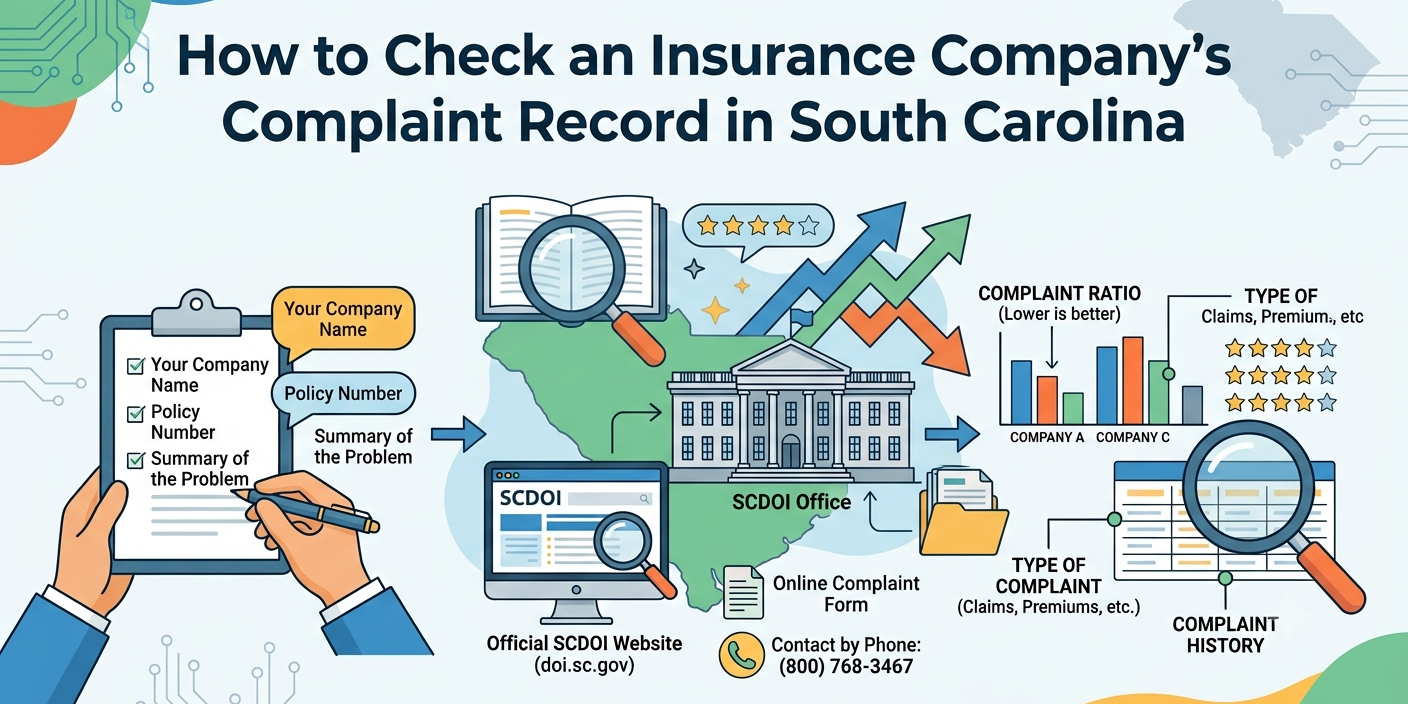
The South Carolina Department of Insurance, the SCDOI, handles consumer complaints against the companies it regulates. Its Office of Consumer Services takes the complaint, requires the company to explain itself within seven days by statute, and reviews the response against South Carolina law and the policy contract.
Every one of those complaints gets recorded and tracked. Once a year the Department rolls the whole year up into a report called the Consumer Complaint Summary, and it publishes a separate one for each line of business:
- Auto and homeowner’s
- Workers compensation and title
- Group accident & health, and individual accident & health
- Group life and individual life
- Group annuity, individual annuity, and long-term care
They live on the Consumer Services page at doi.sc.gov, under the Complaint Summaries tab. Each report covers every company that wrote more than $100,000 of premium in that line in South Carolina.
What is a “confirmed complaint,” and why does it matter?
This is the part most people get backwards, and it is the difference between reading the report correctly and reading it uselessly.
A complaint is any written communication expressing dissatisfaction with a company the state regulates. Somebody was unhappy and put it in writing. That is the whole bar.
A confirmed complaint is a different animal. The Department confirms a complaint when the company violated a state insurance law or regulation, violated a federal requirement the Department has authority to enforce, violated a term or condition of the policy, or when the complaint and the company’s own response together show the company was in error.
That is a real finding, made by an analyst, after the company had a chance to defend itself.
So the number that carries information is not the complaint count. It is confirmed complaints as a percentage of total complaints — how often, when somebody complained about this company, the state looked at it and decided the company was in the wrong.
Why do raw complaint counts mislead you?
Because big companies get more complaints. That is arithmetic, not character. A carrier writing a quarter of the homeowner’s policies in this state will generate more complaints than one writing a few hundred, and the larger one could still be handling people better. If you rank the list by raw count you have essentially ranked the companies by size and learned nothing.
The Department says this plainly in its own guidance: when you are shopping, one factor worth weighing is how a company’s complaint numbers compare to those of other companies of similar size. Similar size. That qualifier is doing most of the work in that sentence. Which is what the market share column is for.
What does the market share column tell you and what does it not?
The reports include U.S. market share: the company’s nationwide premium or policy count divided by the nationwide total. The Department includes it so you can identify which companies carry the most weight in the market and how competitive that market is.
Read the qualifier carefully, though. It is a national figure. It is not that company’s share of South Carolina. A carrier can be small nationally and write a lot of business here, or the reverse. Use market share to sort the list into rough size tiers so you are comparing like with like — and stop there.
Which insurance problems does the SCDOI not handle?
This is the part that costs people the most time, and it is the reason I wanted to write this down. The complaint reports have gaps, and the gaps are not random. There are whole categories of coverage the SCDOI has no authority over which means those problems produce no SC complaint record at all, and calling Columbia about them sends you in a circle.
Medicare Parts A through D and Medicare Advantage
Federal. These sit with the Centers for Medicare and Medicaid Services. 1-800-MEDICARE, or cms.gov.
Self-funded group health plans where the employer is headquartered outside South Carolina
Those go to the U.S. Department of Labor, through EBSA. If your employer is a national company and your plan is self-funded, the state has no lever to pull.
The State Health Plan and PEBA
Self-funded, and the plan’s fiduciary is the Public Employee Benefit Authority. Outside the Department’s regulatory authority. Contact PEBA directly.
Workers compensation, depends entirely on the issue
Claim disputes and benefit issues go to the South Carolina Workers’ Compensation Commission. Class code questions go to NCCI. The Department does handle workers comp rates and forms. Three different phone numbers for three different problems under one heading, which is exactly how people end up calling the wrong one twice.
Medicaid and Healthy Connections, federal employee health benefits, TRICARE
SCDHHS, the U.S. Office of Personnel Management, and the TRICARE program respectively.
If you take one thing from this post, take that list. Most people who lose months on an insurance problem lose them by escalating to an agency that was going to tell them no from the first sentence.
What the Department will and will not do
Worth knowing before you file, so your expectations match reality. The SCDOI can require a company to explain its actions, review that response against South Carolina statute and your policy contract, help you understand your policy, and point you somewhere else if the issue is outside its authority.
It does not regulate customer service quality. It has no authority to compel payment of a claim, negotiate a settlement, determine liability or negligence, or resolve contractual disputes. Fines it imposes are regulatory — the money does not come to you. That is a narrower tool than most people expect. It is still a real one.
How do I check a company right now?
- Go to doi.sc.gov and open the Consumer Services page. Find the Complaint Summaries tab.
- Open the report for the line you are actually buying. Homeowner’s and auto are separate reports, and a company can look different in each.
- Find your company, and find two or three companies near it in market share. Those are your comparisons.
- Compare the confirmed-complaint percentage across that group. Ignore the raw counts.
- Note the report year. This is annual data, so it lags. It tells you about a pattern, not about last month.
- Then put the number down and go ask the harder questions.
What this number cannot tell you
Here is where I will argue against my own post a little.
A clean complaint record does not tell you the policy is right for your house, your trucks, or your nine employees. Most of the bad outcomes I have watched over thirty years did not come from a company behaving badly. They came from somebody being sold a policy that did not match the risk they actually had, and finding out on the worst day of their year.
The complaint report does not measure that. Nothing measures that except somebody sitting down and reading your situation before they quote it. So use the report to screen out. Then judge the rest on whether the person across the desk asked you enough questions to have earned the sale.
The three questions worth more than the report
If you are comparing agents rather than carriers, these get you further than any spreadsheet the state publishes:
- How many carriers are you appointed with in this line, and why did you bring me this one?
- What did you decide I do not need — and why?
- When I have a claim, who picks up the phone: you, or an 800 number?
You will learn more in ninety seconds from those three than from an afternoon with the reports.
Frequently Asked Questions
Is complaint data a reliable way to pick an insurance company?
It is one factor, not a verdict. The SC Department of Insurance says outright that a company’s complaint numbers relative to similarly sized companies is one thing worth weighing among several. It measures how often the state found a company in error, it does not measure whether a policy fits your risk.
Does a confirmed complaint mean a company broke the law?
Not necessarily. The Department confirms a complaint when there was a violation of state insurance law or regulation, a violation of a federal requirement it can enforce, a violation of a term or condition of the policy, or when the complaint and the company’s response together show the company was in error. That last category covers plain mistakes, not just legal violations.
How current is the complaint data?
It is an annual report, so it lags. Check the year on the report you are reading. It describes a pattern over a full year, which is useful for spotting a trend and less useful for judging what happened last month.
Does the SC Department of Insurance handle Medicare Advantage complaints?
No. Medicare Parts A through D and Medicare Advantage plans are under federal oversight through the Centers for Medicare and Medicaid Services. Call 1-800-MEDICARE or go to cms.gov.
My employer’s health plan denied a claim. Do I file with the state?
It depends on the plan. If your employer is headquartered outside South Carolina and the plan is self-funded, it goes to the U.S. Department of Labor through EBSA, not the state. If you are on the State Health Plan, contact PEBA, that plan is self-funded and sits outside the Department’s authority.
Where do I file an insurance complaint in South Carolina?
Through the SCDOI Office of Consumer Services. There is an online form, and a PDF version if you would rather mail it. Contact the company first and give it a chance to resolve the issue, the Department asks you to do that before filing. Have your policy number, claim number, the company’s exact name, and copies of your documentation ready.
Can the Department make my insurance company pay my claim?
No. It has no authority to compel payment of a claim, negotiate a settlement, or determine liability. It can require the company to explain its actions and review that explanation against South Carolina law and your policy.